For our first offering here at the Sitcom Sandwich, we're going to take a look at the classic 70s sitcom Alice. For those of you not familiar with the show, Alice followed the life of widowed single mom Alice Hyatt who dreamed of becoming a singer while serving up burgers at Mel's Diner, a Phoenix greasy spoon run by the cranky Mel Sharples. Alice is joined by co-workers Flo (who eventually leaves the show to be replaced first by Belle and then Jolene) and Vera. Alice's surrogate family is completed by her young son, Tommy.
Alice is an example of several big trends in sitcoms in the mid-to-late 70s. First, like M*A*S*H and The Odd Couple, it was based on a popular film, in this case Martin Scorcese's dramedy Alice Doesn't Live Here Anymore, starring Ellen Burstyn (who won an Academy Award for her role as Alice), Diane Ladd (who would eventually join the cast for season 5 of the series), an Kris Kristofferson. The film followed Alice's life after the death of her abusive husband as she and her son Tommy (played by Alfred Lutter of Bad News Bears fame) head west for her to pursue her singing career and end up in Tucson where Alice is romanced by a rancher. Alice is recovering from multiple abusive relationships but eventually succumbs to the rancher's charms and decides to stay in Tucson. The TV version cuts the Scorcese-esque grit (all references to Alice's past as an abused spouse are gone, as is her sexy rancher boyfriend and Tommy's shoplifting friend, played by Jodie Foster) and doubles down on the comedy.
Alice was also part of the 70s trend of workplace comedies like The Mary Tyler Moore Show and Taxi where co-workers form a tight knit surrogate family of sorts. Alice and her fellow waitresses (and even Mel, who is often a target for their wisecracks and putdowns) are there for each other through thick and thin. The diner is the focal point of much of the show's action, and the relationships between the diner crew are more familial than casual. In the show's finale, Tommy even refers to Mel as a surrogate father. When Vera gets married near the end of the show's run, it is Mel who walks her down the aisle. Outside of Tommy, no other relationship is their lives seems as important as their relationships with each other.
Even more importantly was Alice's place in the wave of feminism that swept through television in the 1970s. The decade saw the debut of many sitcoms featuring strong, independent female protagonists. In addition to Alice Hyatt, the decade gave us Mary Richards (The Mary Tyler Moore Show), Ann Romano (One Day at a Time), Maude Findlay (Maude), and others who were smart and outspoken. Many of these women were working women balancing their careers and social lives. Several were single mothers, and their shows didn't shy away from showing the struggles these women faced as they did their best to support their children. While these women may have had romantic relationships, for most of them, their end goal wasn't necessarily marriage and all its trappings. Alice Hyatt dreamed of a rewarding career outside of the diner. Flo is unashamedly sexually liberated, strong and opinionated but kindhearted and supportive of her friends. While Vera is hopelessly dim, her loyalty to her friends is unshakable. Their friendship would become part of a long line of strong sisterhoods to be found in sitcoms where the relationships these women have with each other becomes more important than any relationship they might ever have with a man.
As the show progressed, the characters became more broad and lacking in nuance, and some of the more serious issues the show tackled initially were lost to catchphrases and stunts. Flo would eventually be spun off into her own show, and Polly Holliday was replaced first by Diane Ladd (who ironically played Flo in the film but here played sassy country singer Belle Dupree) and then Celia Weston as homespun country girl Jolene. Storylines became more absurd with crazy costumes, stunt casting, and a loss of some of the heart that makes the first couple seasons work so well. After nine seasons and 202 episodes, the show shuffled off the scene in March 1985. The show has not become as culturally revered as other 70s classics like All in the Family and M*A*S*H, although its recent inclusion in the Logo lineup hints to a camp appreciation of the show. While the show definitely has its flaws (those last couple seasons with Jolene are really kind of painful when you've seen the earlier seasons), it is deserving of a second look for its championing of a strong, older female characters (Lavin and Holliday were both pushing 40 when the show premiered, and Howland was 35) and the support network they can provide for each other.
So without any further ado, let's examine the Sitcom Sandwich that is Alice.
Episode One Title: "Pilot"
Written by Robert Getchell, Directed by Paul Bogart
Premiere Date: August 31, 1976
Premiere Cast (in opening credits order): Linda Lavin (Alice), Alfred Lutter (Tommy), Vic Tayback (Mel), Beth Howland (Vera), Polly Holliday as Flo.
Guest Cast: Dennis Dugan (Joel), Arthur Space (Stuff Johnson).
Premiere Premise/Plot: The pilot introduces us to our cast about 4 or 5 weeks after Alice Hyatt has started working at Mel's Diner. Within two minutes, we have met all the principal characters: Alice, her smart aleck son Tommy, sassy and randy Flo, grouchy Mel, and dimwitted, clutzy Vera. A young man named Joel (played by Dennis Dugan) has a crush on Alice despite the fact that she is clearly a good decade older than he is, and Mel is not too thrilled that the guy comes into the diner to flirt with Alice and doesn't seem to be a paying customer. Alice rejects the young man's advances, fearing for her job, but when he tells her that he is an agent with connections that could land her a professional singing gig, she reconsiders her rejection and agrees to go out with him. Her thought is that the date can include an audition and that he will be so dazzled by her talent that he will be her ticket out of Phoenix and into the stardom she craves. Flo manages to track down a piano and brings to the diner, and Alice entertains the diner patrons and Joel with a lounge-y rendition of "It Had to Be You." Over dinner at her apartment, Alice keeps trying to steer the conversation to her singing career but Joel keeps deflecting until he finally confesses that he is not an agent and only told her that to get in her pants. Alice is devastated but Flo cheers her up, establishing the support network these women would provide one another for seasons to come.
Key Differences from Series You Remember:
* The opening credits are completely different, showing Alice and Tommy having various adventures such as horseback riding, going on some sort of a wilderness hike, and stopping off for some ice cream that hilariously ends up getting smashed in Alice's face when Tommy opens the door into her face. Later episodes would instead feature exposition-laden clips showing Alice and Tommy on the highway in their beat up station wagon, the car's breakdown, and Alice arriving at Mel's with the "Waitress Wanted" sign along with clips of the characters in action.
* The diner's basic layout is a bit different, featuring different furniture and an altered floorplan.
 * The biggest difference is clearly Tommy. In the pilot, Tommy is played by Alfred Lutter who originated the role in the film. (He and Tayback are the only "survivors" from the film.) By episode two, Lutter is replaced by Philip McKeon. There are no clear explanations for Lutter's departure, but theories floating on the Internet include the idea that Lutter had to leave in order to reprise his role as Ogilvie in The Bad News Bears in Basic Training or that Lutter was deemed not "cute" enough. Regardless of the reason, Lutter ended up okay. According to Wikipedia, he holds both a Bachelor's and Master's degree from Stanford.
Things You Definitely Remember:
* What you remember most clearly about each character is established within the first three minutes of the episode, including Vera's iconic straw explosion that would be part of the opening credits of every episode after this one, Flo's infamous catchphrase "Kiss my grits", and Mel's gruff management style. The core of the show is firmly intact, and the character are established clearly.
Sign of the Times
Watching classic sitcoms is sometimes an exercise in checking your 2017 sensibilities and marveling at how much times have changed. Here, we get the character of Stuff Johnson. Stuff is an elderly diner regular who shuffles in and promptly assaults Flo by grabbing her ass and then lures Alice into the storeroom with a promise of a candy bar where it is clearly implied he grabbed her. Stuff is played for laughs -- isn't it hilarious that this old man is playing grab ass with these women just trying to do their jobs? In 2017, we would call this sexual assault; in 1976, it was high comedy.
Episode 202 Title: "Th-th-th-that's All, Folks"
Finale Date: March 19, 1985
Finale Cast: Linda Lavin (Alice), Vic Tayback (Mel), Beth Howland (Vera), Philip McKeon (Tommy), Charles Levin (Elliot), Celia Weston (Jolene)
Guest Stars: Dave Madden (Earl), Duane R. Campbell (Chuck), Douglas Robinson (Doug), and Marvin Kaplin (Henry)

Finale Premise/Plot: The show opens with Mel announcing to the diner regulars that real estate developers have offered him a small fortune to buy the diner with the plan being to demolish the building and build anew. He is concerned about how he will tell the waitresses that their jobs are soon to be no more, but his concerns are moot when Alice and Jolene walk in and inform him that they both, conveniently, have news. Alice is going to go to Nashville to join a country singer who had appeared earlier in the season to finally pursue a professional singing career. Meanwhile, Jolene's Grammy Gumms has died, leaving her enough money to buy a beauty shop. Vera soon walks in with her own news -- her police officer husband Elliot has been promoted to detective. When Vera learns of the impending destruction of the diner, she promptly faints. After a trip to the hospital, Vera returns to the diner with even more news -- she's pregnant. This all happens within the first five minutes of the episode. From there, the show pretty much dissolves into a clip show as the diner crew (along with Tommy, who is now a college student, and Elliot) spends one last evening in the diner before its demolition to remember all the good times they had together. They bid a teary farewell to diner regulars Earl, Chuck, and Henry. The audience is then treated to a series of montages including clips of Tommy entering the diner (and tracking how he's aged since episode two), Mel yelling "stow it", people slamming Mel's food, celebrity cameos (including George Burns, Art Carney, Debbie Reynolds, Donald O'Connor, Dinah Shore, and more), and Alice offering unsolicited advice. Mel presents his waitresses with cow coffee creamers as well as checks for $5000 each, their share of his profit from the sale of the diner. Things grow bittersweet as Tommy thanks Mel for being a second father to him and Vera and Elliot inform Mel that they plan to name their child Melvin if it's a boy. The crew tearfully files out as Mel turns the sign to "Closed" and locks the diner doors for the last time.
Difference from Premiere (How did the show evolve) :
* Philip McKeon now plays Tommy, who has grown into a handsome, athletic, young college student.
* Vera is married.
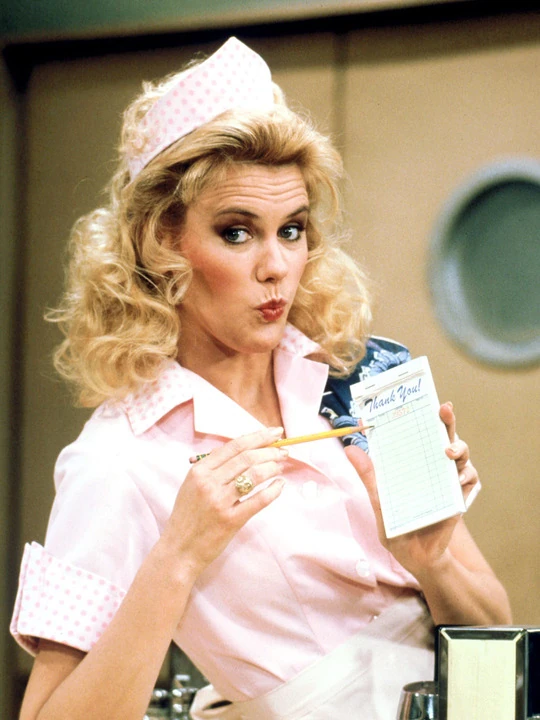 * The biggest difference is the absence of Flo and the presence of Jolene. This becomes significant in many ways beyond just a different face. Flo was the early breakout character of the show, which allegedly caused trouble between Polly Holliday and Linda Lavin. The story is that Lavin was jealous of Holliday's popularity and the critical acclaim she received and made things so uncomfortable that Holliday abandoned ship for her own spinoff, Flo. (Stories also circulate that Diane Ladd, Holliday's replacement, received similar treatment from Lavin after Ladd won a 1981 Golden Globe (tying with Valerie Bertinelli of One Day at a Time) and Lavin lost to Katherine Helmond of Soap. Ladd left the series after one season because of Lavin's jealousy.) Losing Flo left the show with a gaping hole that the show was never able to fill successfully. In Flo, the show had a classic comic character -- a brassy, gum chewing dame whose randy behavior belied a huge heart of gold. Flo was a frank, sexually liberated woman who owned her sexuality with no shame, a character who paved the way for other such brazenly liberated female characters like Blanche Deveraux, Roz Doyle, and Samantha Jones. Flo was a good time gal who was fiercely devoted to her friends, and the friendship between Flo and Alice, in particular, was a realistic portrayal of the relationship women forge with their friends. Losing Flo stripped the show of that friendship. While Alice was friends with Vera and Jolene, the closeness and intimacy that Flo and Alice shared was completely lost. Jolene was a pale replacement for Flo. It was as if the writers looked at what made Flo a breakout -- the sassiness, the Southern accent, and the wisecracks -- and thought that was all that was needed to replace Flo. Jolene lacks much of Flo's warmth and intelligence, and so we're left with a shell of a character.
At the end of the run, Alice has lost much of what made the first seasons special, and you get the sense of a missed opportunity. Instead of embracing the potential offered by the show's blue collar roots and mining comedy from the struggles of Alice and her co-workers to make it in a world that isn't always easy for the working class, the show steered into the skid many sitcoms headed into in the late 70s and early 80s and relied more and more on crazy stunts and plotlines. It's interesting to note that the show's critical acclaim largely disappeared following Holliday's departure with Emmy and Golden Globe recognition drying up outside of a couple Golden Globe nominations for Howland and Tayback and an Emmy nomination for directing for the ninth season episode called "Tommy's Lost Weekend" that examined Tommy's developing drinking problem (that was promptly solved in one episode the way such problems were in the 1980s). There were attempts to tackle some issues -- Alice combatting ageism when she is fired from her job singing at a local lounge, Vera becoming an activist against animal abuse -- but there were more episodes featuring stunt casting (including a crossover appearance by Boss Hogg and Enos from Dukes of Hazzard, not to mention multiple appearances by Lavin in old age makeup as Vera's landlord) and crazy plotlines (like Jolene and Mel being glued together). Instead of becoming a classic from the era, the show is a pleasant diversion on a Saturday afternoon when you stumble across it on Logo. A missed opportunity to be sure.